
BLOG-1
The Therapist – Client connection in the therapy room
I‘ve been working as a therapist for more than 3 years and one thing that keeps me going is the relationship that I’ve built with my clients. In my opinion, it’s very important for the therapist and client to have a connection, which strengthens the therapeutic relationship and changes the way ‘shift’ happens in therapy.
I’m happy for them, sad for them, I pray for them, think about them during the week and also do a happy dance after the session when they share something meaningful that happens with them (Like, when a client recently told me she got her dream job, another one got divorced after being in an abusive marriage for years, one finally started going to work after not being able to due to depression, and one gave a ted talk after going through the toughest time of her life and so on…) It makes me the happiest when they share these achievements with me with so much joy and excitement and feel honoured to be a part of their journey in a small way.
After being with them ‘in the trenches’, watching them go through the toughest time of their life, their ability to fight through it all gives me the strength to fight my own sometimes. It’s amazing how they understand my boundaries and I understand theirs, and there is mutual respect for each other in that space. I have witnessed them crying, hurting, being angry, and I’ve genuinely with all my heart prayed for things to get better for them. And this part of being a therapist is something no one teaches you in your training and education. Like all therapists, I also doubt myself but I am proud of the therapist I am becoming and a better human too.
To all my clients, When you enter therapy with me, just know I’ll be with you in good and bad both with all my heart, if you let me. Thank you for unknowingly giving me hope and teaching me so much more than you can imagine.
If you’re still reading this and you’re in therapy, just know that your therapist cares about you deeply and wishes only the best for you. And no, we are not in it only for your money, we are there for you because we genuinely care.
BLOG-2
Can’t pinpoint but something’s off? Here’s a tool to put your words into feelings.
How many times do you find yourself stuck in the loop of ‘I don’t know?’ Sometimes when our inner world feels chaotic, it can be hard to figure out exactly what you’re feeling and the appropriate reaction to it but putting a finger to your feelings can sometimes be really helpful to understand and deal with it better.
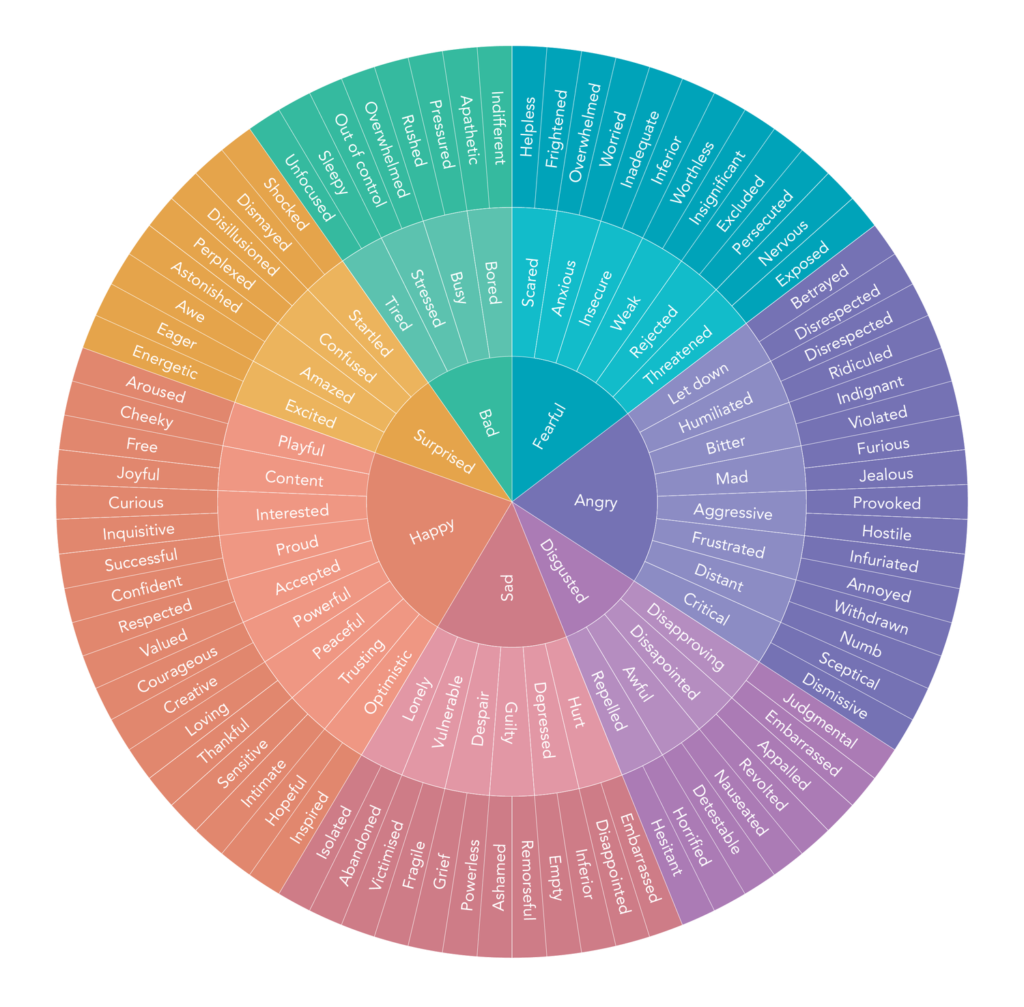
The feeling wheel is a powerful psychological tool which is also used by therapists in therapy with clients to identify and verbalise their emotions. The wheel identifies primary human emotions and tiers of related, more nuanced versions of those emotions.
Primary emotions are basic emotions that we are born with that have been conditioned into our brains. Along the outermost part of the feeling wheel are the low-intensity emotions and as you move toward the centre, the milder emotions become your basic emotions. We also have secondary emotions, which are emotional reactions to an emotion such as the feeling of shame when angry or feeling fear as a result of anger.
The emotion wheel helps you to be more open, honest, curious, and mindful about yourself.
How to use the wheel:
Scan this wheel to figure out what emotion best describes your current state and then allow it to empower how you want to meet the moment. Start with the basic emotions and then keep going until you find the word that closely describes your emotional experience.
Try and see if it helps you to identify and acknowledge your emotions.
Disclaimer: If it gets overwhelming or you are in distress, please reach out to a mental health professional.
A LETTER TO MYSELF
Download it, save it in your phone and read it whenever you feel low to pick yourself up.
(This is one of the pages from our ‘Mental health journal-A warm hug’. To buy the journal, tap here. )
